Bermuda Triangle Uncovered: Secrets of the Sea That Swallows Time
For more than a century, a vast stretch of ocean in the western North Atlantic has inspired fear, fascination, and relentless debate. Known as the Bermuda Triangle, this loosely defined region between Florida, Bermuda, and Puerto Rico has been linked to some of the most puzzling maritime and aviation incidents in modern history. Ships have vanished without distress calls, aircraft have disappeared from radar, and survivors have described baffling navigational failures in otherwise calm conditions.
Yet despite its reputation, the Bermuda Triangle remains one of the most misunderstood places on Earth.

A Legacy of Vanishings
The legend gained traction in the mid-20th century after a series of unexplained losses, including the infamous 1945 disappearance of Flight 19, a group of U.S. Navy training planes that vanished during a routine exercise. Reports of spinning compasses, malfunctioning radios, and sudden weather shifts fueled speculation that something extraordinary lurked beneath the waves.
Over time, sensational explanations emerged: magnetic vortexes, alien abductions, time warps, and underwater civilizations. Popular culture amplified the mystery, transforming the Triangle into a symbol of the unknown.
But modern research suggests the truth may be both less fantastical—and more complex.
Magnetic Anomalies and Navigational Challenges
One of the most persistent claims involves unusual magnetic behavior. Unlike most places on Earth, where compasses point toward magnetic north rather than true north, the Bermuda Triangle lies close to a region where the two align. This rare coincidence can cause navigational confusion, particularly for older instruments or inexperienced operators.
Oceanographers also point to the region’s powerful currents, including the Gulf Stream, which can rapidly carry wreckage far from its original location. This helps explain why debris from missing vessels is often never recovered, reinforcing the illusion of sudden disappearance.
Extreme Weather and Rogue Waves
The Triangle sits at the crossroads of unpredictable weather systems. Sudden storms can form with little warning, and towering rogue waves—once considered mythical—are now scientifically documented. These massive walls of water can overwhelm large ships in seconds, leaving no time for distress signals.
A combination of shallow reefs, deep trenches, and volatile atmospheric conditions creates a uniquely hazardous environment, particularly before the age of satellite navigation and modern forecasting.
New Technology, New Questions
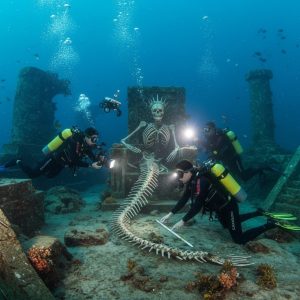
Recent advances in deep-sea exploration have renewed interest in the region. Autonomous drones and sonar mapping systems have revealed unusual underwater formations—steep ridges, massive sinkholes, and ancient-looking rock structures shaped by erosion and tectonic activity.
While some images circulating online claim to show submerged ruins or artificial structures, experts caution against overinterpretation. “The ocean floor plays tricks on the eye,” says one marine geologist. “Natural formations can appear remarkably symmetrical.”
Still, unexplained sonar readings—objects larger than known sea life—continue to spark curiosity, even among cautious scientists.
Separating Myth From Reality
Despite decades of speculation, no credible evidence supports claims of portals, extraterrestrial involvement, or supernatural forces. Statistical analyses show that ship and plane losses in the region are not significantly higher than in other heavily traveled ocean corridors.
However, the Bermuda Triangle persists as a mystery not because it defies science—but because it sits at the intersection of human error, environmental extremes, and the limits of early technology.
In many cases, disappearances once attributed to the Triangle were later explained through recovered records, revised weather data, or improved navigation models.
Why the Mystery Endures
The enduring power of the Bermuda Triangle lies not in what it hides, but in what it represents. It reminds us that despite satellites, sensors, and global positioning systems, the ocean remains vast, powerful, and only partially understood.
More than 80 percent of the world’s oceans remain unexplored. Beneath the waves are mountains taller than Everest, trenches deeper than the Grand Canyon, and ecosystems barely studied. In that context, mystery is not an anomaly—it is the norm.
A Sea That Demands Respect
The Bermuda Triangle does not choose victims, nor does it swallow time. What it does is expose the fragile boundary between human confidence and nature’s indifference. Each investigation, each technological breakthrough, brings us closer to understanding—not only this infamous region, but the oceans as a whole.
As exploration continues, one truth becomes increasingly clear: the Bermuda Triangle is not a gateway to the impossible, but a reminder of how much of our planet still waits to be fully understood.
And perhaps that is mystery enough.