Herculaneum’s Forgotten Shore: Where an Ancient World Took Its Final Breath
Along the sunlit coast of southern Italy lies a shoreline unlike any other—a quiet stretch of sand that once echoed with voices, footsteps, and the rhythms of Roman daily life. This is the ancient beach of Herculaneum, a prosperous Roman town forever frozen in time when Mount Vesuvius erupted in 79 AD. Unlike its more famous neighbor Pompeii, Herculaneum tells its story not through streets dusted in ash, but through haunting preservation beneath hardened volcanic mud and lava.
Today, archaeologists and visitors stand on this shore confronted by one of antiquity’s most intimate tragedies: rows of human skeletons uncovered along the waterfront, the remains of men, women, and children who fled toward the sea in a desperate attempt to escape annihilation.

A Different Kind of Destruction
When Vesuvius erupted, Herculaneum did not receive the slow rain of ash that buried Pompeii. Instead, it was struck by superheated pyroclastic surges—avalanches of gas, ash, and volcanic material that moved faster than any human could run. Temperatures soared high enough to instantly kill anyone in their path.
Ironically, this brutal force preserved the city with extraordinary detail. Buildings were sealed rather than crushed, wooden furniture carbonized instead of destroyed, and organic materials—doors, beds, even food—survived in ways almost unheard of in Roman archaeology.
“Herculaneum offers a snapshot of Roman life unlike anywhere else,” says one archaeologist working at the site. “It’s not a ruin—it’s a moment.”
The Skeletons on the Shore
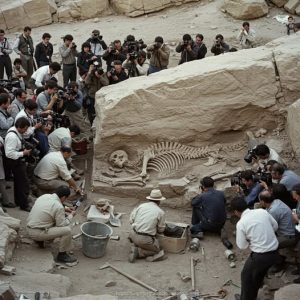
The most powerful discoveries came during excavations of the ancient beachfront. Archaeologists uncovered hundreds of skeletons clustered inside stone boat sheds, once believed to house fishing vessels and cargo. Instead, they had become shelters of last resort.
Scientific analysis reveals the victims were likely waiting for rescue by sea. Many still carried coins, keys, jewelry, and tools—belongings gathered in haste as they fled their homes. Some skeletons show signs of embracing, others crouched or pressed against walls, all caught in the final seconds before the deadly surge engulfed them.
Recent studies suggest death was instantaneous. The intense heat caused organs and tissues to vaporize almost immediately, sparing victims prolonged suffering but sealing their fate with horrifying certainty.
A City Preserved in Daily Life
Beyond the shoreline, Herculaneum’s streets reveal an astonishing level of preservation. Elegant villas with frescoed walls, public bath complexes, shops, and taverns remain standing, offering rare insight into Roman urban life. Graffiti still clings to walls. Upper floors—long lost in Pompeii—survive here.
Wooden balconies, staircases, and furniture allow historians to reconstruct how Romans lived, rested, and socialized. Even remnants of food—bread, nuts, fruits—have been found, turning archaeology into a deeply human experience.
“Herculaneum doesn’t just show how people died,” one historian explains. “It shows how they lived—right up until the end.”
Science Meets Memory
Modern forensic techniques have transformed the site into a bridge between ancient history and contemporary science. DNA analysis, isotopic studies, and skeletal examination reveal information about diet, health, social class, and migration patterns of Roman citizens.
Far from anonymous remains, the skeletons are now understood as individuals—parents, laborers, merchants, and children—caught in a disaster beyond imagination.
A Silent Witness to Fragility
Walking along Herculaneum’s ancient shore today is a humbling experience. The sea still laps gently against the land, indifferent to the catastrophe it once witnessed. Where laughter, trade, and leisure once flourished, silence now reigns.
Herculaneum stands as a reminder of life’s fragility and the suddenness with which civilization can be undone. Its beach, once vibrant with activity, now preserves one of history’s most poignant human moments—fear, hope, and the instinct to survive, frozen forever in volcanic stone.
This forgotten shore does not ask to be remembered. It simply waits—bearing witness to an ancient world that lived, loved, and vanished in a single, devastating day.